
By Kylie Lancaster //
Graduation ceremonies are filled with ritual, and Hood College’s commencement features both common practices and Hood traditions.
Here are insights into some of these customs:
The Hood College Alma Mater
The Hood College alma mater was first listed in a commencement program in 1980.
Hood College historian Mary Atwell said the introduction of the alma mater may have been due to the honorary degree recipient being European royalty that year.
The song was written by Gertrude B. Hoy, a 1912 Hood College graduate. Hoy was born in Tokyo and moved to Lancaster, Pennsylvania, when she was 12.
Hoy went on a mission trip to China as a missionary teacher after graduating and became the principal of a girls’ school in Yueyang, China.
The song has remained in Hood College’s commencement program since 1980.
Hood College Dink
Students conclude their college journey wearing a mortar board hat, but they begin their time at Hood wearing a dink.
The dink first appeared in campus publications in 1951 as a symbol of the Hood College freshman class.
Felt beanies were common at American colleges and universities in the first half of the 20th century.
First-year students were often required to wear felt beanies for a period during the first semester. The dinks helped others identify new students on campus.
Before the felt beanie was introduced at Hood College, first-year students wore armbands with their names embroidered on them until mid-October.
Hood College dinks feature four class colors: red, yellow, blue and green. The colors are recognized as symbols of class unity.
The dink color for the Class of 2026 is yellow.
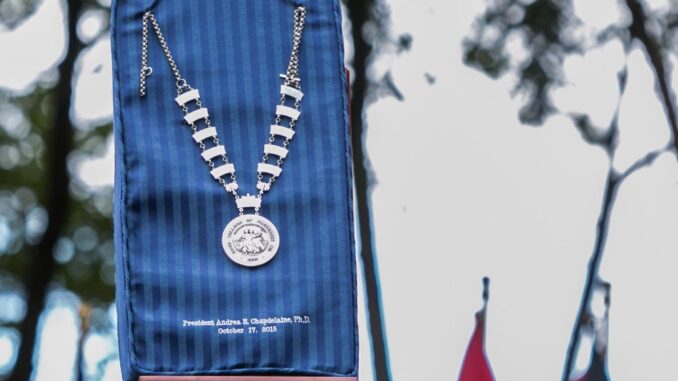
The Presidential Chain of Office
The presidential chain of office is specially made for each president’s investiture and is a symbol of leadership, trust and honor.
“Historically, chains of office were ceremonial badges worn by high-ranking people during the Middle Ages of Europe,” Atwell said.
The chain of office is now a metal necklace worn by an academic institution’s president on ceremonial occasions as part of the official regalia.
Ronald J. Volpe was the first Hood College president to receive the chain of office. President Chapdelaine and President Ricker have also received the chain.
The Hood College Mace
The mace was introduced at convocation on Aug. 24, 2015. It is a symbol of academic leadership.
“The origins of the mace can be traced to medieval times when knights carried them as weapons during processions with their kings,” Atwell said. “As the tradition grew, the mace became a symbol of authority and was often decorated with elaborate embellishments and gems.”
Today, the academic mace represents the authority granted to the institution’s president and is used only on formal academic occasions.
The mace is composed of three parts: the seal, the collar and the staff. Each part highlights something important within the college’s history and structure.
The seal features Hood’s motto, “corde, et mente, et manu.” The collar is inscribed with the college’s former and current names, as well as the date of establishment. The staff highlights the four pillars of Hood: hope, opportunity, obligation and democracy.
Graduation Cap and Gown
The tradition of wearing a cap and gown during commencement dates to the 12th century.
The gowns were not only a symbol of a scholar’s status but also a way to keep warm in cold, stone university buildings.
The cap was also designed to aid scholars when studying and reading by candlelight because of its square shape.
The Intercollegiate Code of Academic Costume set the standard for academic dress as the cap and gown, which is still honored by colleges and universities today.
The cap and gown are now seen as symbols of the transition between student and graduate and highlight achievement over attire.
Turning the Tassel
The tassel is an essential part of graduate regalia attached to the cap.
Turning the tassel during commencement symbolizes academic achievement, transition, unity, celebration and future endeavors.
At the collegiate level, graduates start with the tassel on the right side and move it to the left once the degree is awarded.
##



Be the first to comment