
By Michaiah Varnes//
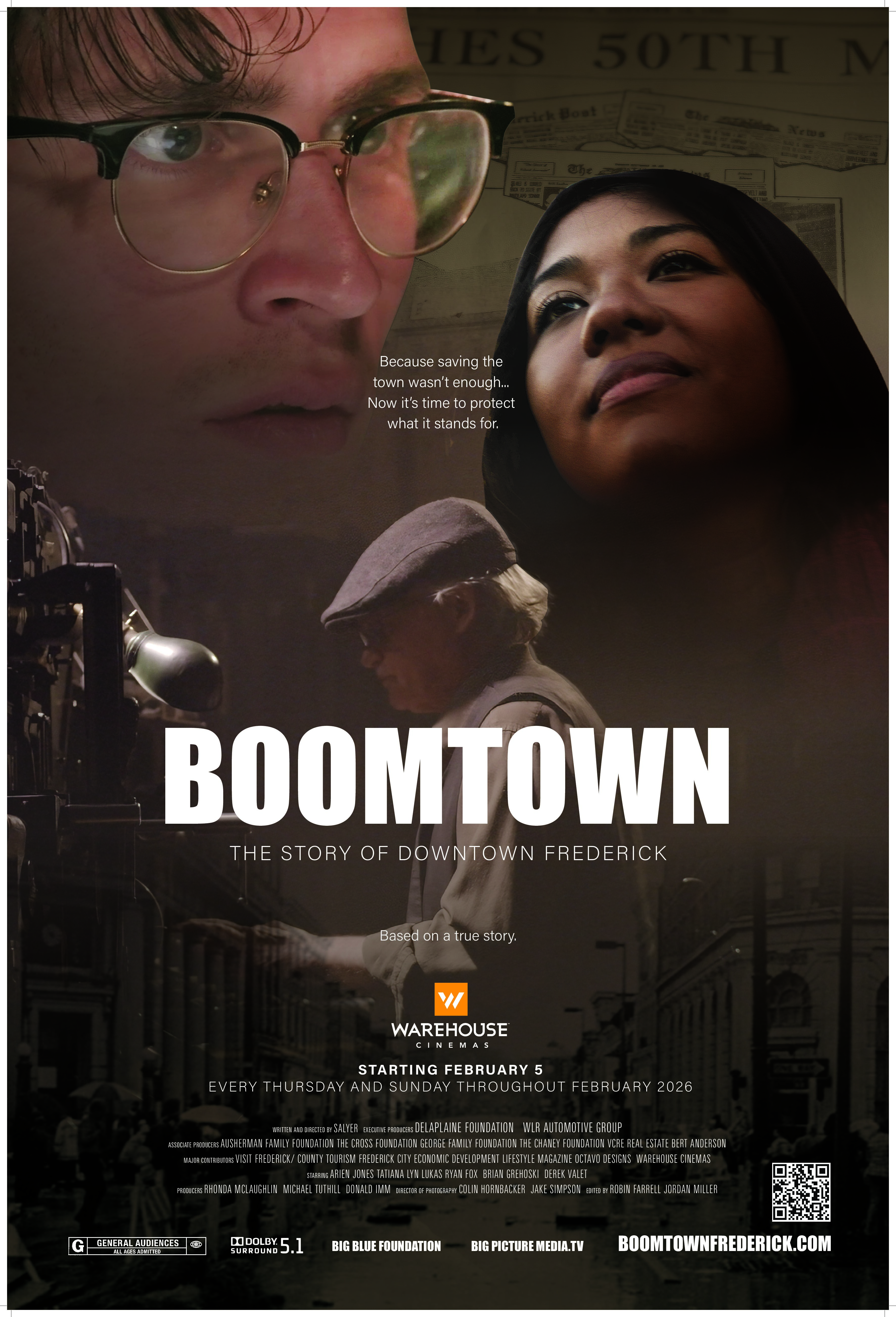
A new docudrama this year brings Frederick’s past into the present, tracing how a group of unlikely rebels in the 1970s sparks a creative uprising that reshapes a struggling town and how that legacy continues to echo today.
“BOOMTOWN,” inspired by true events, follows residents in 1970s Frederick who launch a local cultural revival at a time when the city faces economic decline.
In 2025, the film centers on Lexi Brown, a bold Hood College student with deep local roots, who returns home to explore her late father Amos’s newspaper archives. As she uncovers forgotten stories, she begins to see the connections between the city’s past and its future.
The docudrama held its first-run screenings at Warehouse Cinemas Frederick in the Frederick Towne Mall.
Portions of the film were shot on Hood’s campus, and one of the main characters is depicted as a Hood student, often shown wearing a Hood beanie.
The filmmakers say they are exploring ways to partner with Hood as “BOOMTOWN” begins its wider run, including festival submissions, public television opportunities and civic-focused screenings.
Director Salyer McLaughlin, who moved to Frederick in 1996, says the inspiration for the film came after reading “From the Brink to Brilliant,” a book that details the transformation of downtown Frederick following the catastrophic 1976 flood.
“My mother told me I should look into Frederick’s history, and when I returned from Los Angeles, I started reading about the city,” McLaughlin said. “After I read the book, I realized this was a great story that hadn’t really been told yet.”
McLaughlin said securing community support was key to launching the project.
“I went and got the support of the city, economic development, folks in tourism and several foundations,” he said. “Eventually, we raised half a million dollars to make the movie.”
He also described the film as an opportunity to grow as a director.
“It gave me the ability to coach actors, which I hadn’t really done before,” McLaughlin said. “Most of my background was in commercials, short videos and documentaries, but not dramatic scenes.”
McLaughlin’s wife, Rhonda McLaughlin, serves as the film’s producer.
The film’s opening scene features Amos Brown, chief photographer at The Frederick News-Post, narrating his coverage of the 1976 flood and its devastating impact. The film then shifts to April 7, 1968, the day after the assassination of Dr. Martin Luther King Jr. with coverage of the gathering at Asbury United Methodist Church.
McLaughlin said the Asbury scene is his favorite and one of the most meaningful in the film.
“It carries the most weight,” he said. “It was important to get that right and to capture the sense of the congregation.”
Collaboration with local historians shaped the film’s accuracy. McLaughlin credited Hood professor Tim Jacobsen and Hood archivist Mary Atwell for their guidance.
“We needed a photo lab for the Amos Brown scenes, and we ended up using the lab at Hood College,” he said. “Mary Atwell is our Claire McCardell expert. She gave me great information about McCardell’s career and even loaned me books. We shot a microfilm scene using her equipment.”
At the time depicted in the film, Frederick was known as the “Cinderella City” for its economic growth potential. Landmarks referenced in the movie include the Delaplaine Arts Center, the Weinberg Center for the Arts, the Frederick Festival of the Arts, and Brewer’s Alley.
McLaughlin said he hopes audiences walk away, understanding that meaningful change begins with everyday people.
“Revolutions don’t wait for permission,” he said. “It was about preservation, preserving our beautiful architecture, our churches, our banks, our City Hall, our post office, our government buildings.”
##


Be the first to comment