
By Mel Carmel //
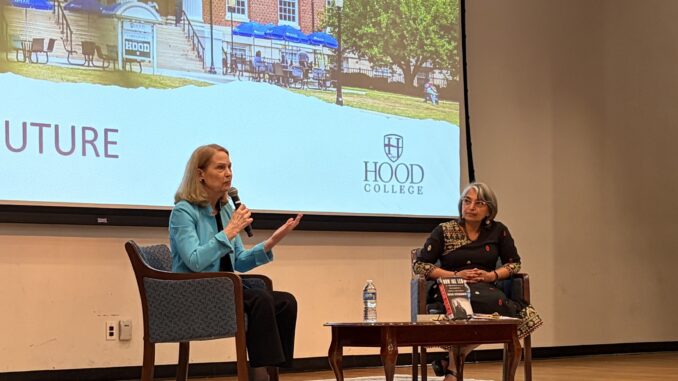
Susan Eisenhower, granddaughter of former President Dwight D. Eisenhower, spoke about leadership, political division and the future during a Sept. 30 lecture at Hood College.
Eisenhower delivered her lecture, “Leadership in Times of Uncertainty with Hearts, Minds and Hands,” from 5 to 6:30 p.m. in Hodson Auditorium. The event was free and open to the public and was presented through the Hansen Lecture Series.
Eisenhower, a policy strategist specializing in national security, strategic issues and leadership development, discussed her grandfather’s leadership style and how his approach could provide lessons for navigating uncertainty today. Nisha Manikoth, director of the Doctoral Program in Organizational Leadership at Hood, facilitated the discussion. Hood President Debbie Ricker opened the event by welcoming the audience and introducing Manikoth.
Eisenhower said one of the most important characteristics of her grandfather’s leadership was his ability to remain optimistic and bring people together, even during times of crisis. During World War II, Eisenhower served as supreme commander of the Allied forces in Europe. According to his granddaughter, his leadership during the war was marked by optimism, listening and cooperation.
“He was always about opportunity and optimism,” Eisenhower said.
She said Eisenhower’s ability to unite people was especially important during D-Day, when he commanded American and Allied forces during the invasion of Normandy. The operation involved 156,000 troops landing within 24 hours and required cooperation among multiple nations and branches of the military.
Eisenhower also described her grandfather’s approach to political conflict, particularly during the McCarthy era. Rather than publicly confront former Sen. Joseph McCarthy, Eisenhower worked behind the scenes to limit his influence.
“He said to his family, and everybody else who was sort of screaming at him, ‘Please, get up and say something,’” Eisenhower said. “He says, ‘I’m not going to give him what he wants.’”
She said the strategy allowed her grandfather to avoid giving McCarthy additional attention while working privately with members of Congress to counter him. Eisenhower said another lesson from her grandfather was the importance of avoiding unnecessary escalation.
“Never corner anybody,” Eisenhower said. “All it does is escalate the situation.”
She connected that principle to current political divisions in the United States, saying Americans no longer have the same shared goals and experiences that brought previous generations together.
“We don’t have a shared goal anymore, and we don’t have a shared experience,” Eisenhower said. “And without those two things, it’s going to be a challenge I think, to put this back together.”
Despite the political division, Eisenhower said she remains optimistic about the country’s future. She encouraged people to view debate and disagreement as opportunities to develop a shared understanding of national identity. “We can share an experience called debate,” she said. “And sharing our ideas about what our national identity is.”
Eisenhower also addressed the growing role of artificial intelligence and its potential impact on leadership and society. She said Hood’s motto, “Corde, et mente, et manum,” meaning “with heart and mind, and hand,” is particularly relevant as technology develops. She argued that human emotion and creativity remain qualities that technology cannot easily replace.
“Human beings are more emotional and sentimental than they are intellectual or logical,” Eisenhower said.
While she acknowledged the usefulness of AI, Eisenhower questioned whether the technology can create the kind of original ideas that have shaped history. She pointed to the Allied forces’ use of artificial harbors during D-Day as an example of human creativity and problem-solving. Eisenhower said effective leadership requires understanding the emotions and motivations of others rather than simply reacting to conflict.
Her lecture concluded with a reminder that leaders should listen, observe and understand before choosing how to respond.
“He didn’t fight every fight,” Eisenhower said of her grandfather. “He understood.”
##
Be the first to comment