
By Piper Wright and Aaron Heller//
Nick Reinarts, an assistant professor of economics, loves teaching at Hood College.
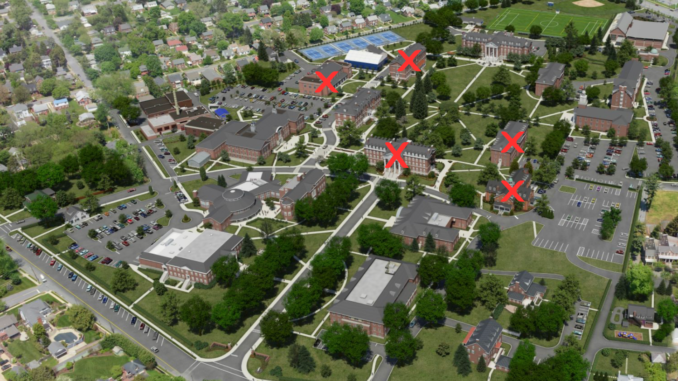
But Reinarts is unable to get his mail from the post office in Gambrills Gymnasium or meet with the provost or president in their offices in Alumnae Hall.
Reinarts suffers from spina bifida, which requires him to use a wheelchair.
“I have been wheelchair bound since I was around two years old,” he said.
While his disability didn’t limit his academic achievements, the aging buildings at Hood College restrict where he and others can go. Injured athletes and faculty, students and staff with both permanent and temporary disabilities struggle to navigate the campus.
In addition to Gambrills and Alumnae, Smith and Meyran dormitories are also inaccessible for those using wheelchairs or scooters. Other buildings, while accessible, pose risks, Reinarts said.
“The big issue with this building (Rosenstock Hall) is the elevator and a lack of an emergency evacuation plan for this building for disabled students,” said Reinharts, who teaches in Rosenstock. “The only disabled entrance to this building is on the ground floor, but what happens if fire alarms go off in this building, if the elevator doesn’t work? What am I supposed to do, and if all of the other exits involve stairs, am I just supposed to sit there calmly and wait for help to arrive?”
Bridget Humphries, the director of Accessibility Services, said the college is working to address problems with access and safety.
“We are working towards getting a kind of self-assessment of all our spaces on campus and then developing a plan to kind of tackle the most urgent,” she said.
College officials recently went on a tour of the campus to identify spots that are inaccessible or difficult to reach.
Reinarts suggests adding portable ramps throughout all of the buildings, adjusting bathroom stalls to better fit wheelchairs and purchasing evacuation chairs for all buildings in case of emergencies.
The need for better access goes beyond that of one professor.
Sophomore Kady Krazter faced accessibility problems at the beginning of the semester when dealing with a sports-related injury that required her to use a scooter for three weeks.
“Mainly all of the buildings are accessible, but I think that making it known where the accessible entrances are is important,” Kratzer said.
“Because I know, like, there were many times where I was late to class because I had to scoot my way around the building to try and find the elevator entrance, like Tatem, I didn’t know it was in the back.”
Kratzer added that many of the handicap doors around campus don’t work and suggested that they should be fixed for anyone who needs to use them.
Humphries said that Hood accessibility services are one-on-one with the student or faculty member, matching their needs to the spaces that are available.
Reinarts is urging the college to act quickly to improve access for all.
“The goal is to push the timeline,” he said. “If we get more voices out there, then hopefully they move the time up because I trust and believe that they’ll (Hood) get it done.”
##

Be the first to comment