By Piper Wright //
Hood College students and staff presented research projects ranging from cat genetics to racial biases in baseball broadcasting at the SPIRES symposium on April 20.
The symposium included poster sessions, oral presentations, panel discussions and performances across campus.
SPIRES, which stands for Scholarship, Performance, Innovation and Experience, serves as a way for students at Hood to present their work in a professional setting while engaging with peers and mentors.
The morning sessions focused on undergraduate poster presentations. Students stood in the Whitaker Campus Center commons room with visual displays summarizing their work, while answering questions from attendees.
Senior Alisa Gorham presented her Yeager Lab Cat Genetics project with the help of professor Meredith Yeager.
Gorham’s main goal for this project was to create a design method to send out mass genetic information to cat owners, specifically regarding cats’ fur coats.
Anyone on Hood’s campus could participate in the study by taking the provided swab bag, which included a QR code linking to a form to enter information about their cat, such as age, eye color and coat pattern. After basic information was collected, researchers began processing the samples.
“We took your swab and sliced it open, basically we broke up the cells and extracted the DNA, and we quantified the DNA and made sure that it was pure,” Gorham said.
The project generated more than 280 DNA samples and over 500 genotypes. These samples were also used in classroom labs, schools and other student projects.
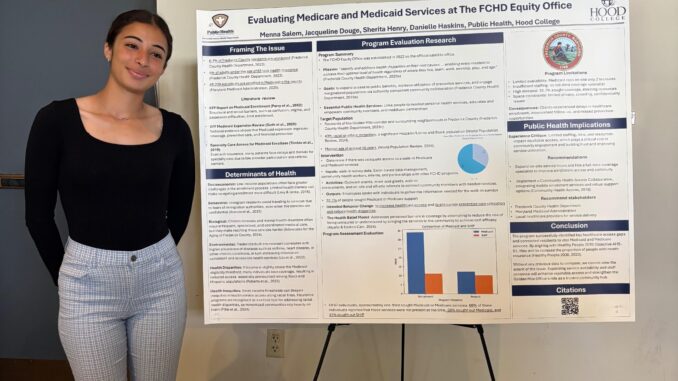
Senior Menna Salem presented her research project evaluating Medicare and Medicaid services through the Frederick County Health Department, specifically focusing on the Golden Mile area.
Services such as Medicare and Medicaid are meant to ensure that underinsured communities have the proper resources to access healthcare.
“About 30-32% of people who came in wanted to seek health insurance and aid, whether that’s enrolling or ensuring that their Medicare and Medicaid services are up to date,” Salem said. She found that the office was only staffed twice a week, making it difficult for clients to get help.
The goal of Salem’s research was to show that there is a high demand for Medicaid and Medicare services, particularly Medicaid, and to demonstrate to the state that underinsured communities need proper assistance.
In the afternoon session, students gave oral presentations and participated in panel discussions. These sessions typically included short presentations followed by time for questions.
Communication Arts senior Amrit Brown presented his research project on racial biases in baseball broadcasting, using AI-assisted coding known as CODEX, to conduct a content analysis of broadcaster language.
Brown’s research centered on two different questions: whether broadcasters use different descriptive language based on players’ race, and whether that language has changed over time.
The study analyzed 45 locally broadcast MLB games from 2023 to 2025, using 15 games per season. Players represented 18 different countries, and 90% of broadcasters were identified as white and male.
Brown’s findings showed that racial biases in commentary does exist. Certain traits such as aggressiveness, speed, and natural talent, were more frequently described to players of color, while white players were often described using terms related to intelligence and experience.
Brown examined the trends over a three-year span and did not find statistically significant changes during that period, mainly due to limited data.
The study argued that while baseball broadcasting has evolved, racial bias still exists. These biases can influence how the audience perceives players, and the lack of diversity among broadcasters may also contribute to these patterns.
Brown recommended expanding future research to include more games, national broadcasters and a deeper analysis to better understand the causes behind these trends.
##


Be the first to comment