
By Staff//
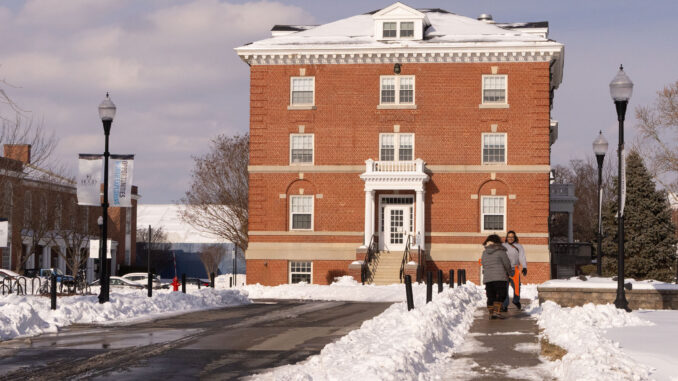
The massive winter storm that occurred in late January forced Hood College to make difficult decisions regarding cleanup efforts, campus operations and academic affairs.
This storm dumped between 9 and 12 inches of snow, which was covered by sleet and freezing rain. Temperatures plummeted to the single digits.
President Debbie Ricker acknowledged that the snow was not necessarily the problem, but rather the ice and freezing rain that made cleanup efforts incredibly challenging.
“This precipitation was different,” Ricker said. “It was like concrete, and so difficult to move.”
“The facilities crew, consisting of the director, the maintenance manager, and nine staff members, has logged more than 100 combined hours of labor,” Director of Facilities Cathy Thomas said.
Many of the team members stayed on campus throughout the storm, some sleeping in offices on cots or other available campus spaces.
Some of the large pieces of equipment used to move the snow now broke, and the college was forced to subcontract additional cleanup support. Employees of BrightView Landscapes were brought in to help clear the steps around campus, while another company helped provide sidewalk clearing services.
These obstacles left Ricker, as well as interim Provost Paige Eager, Vice President Tammi Simpson, Dean of Students Demetrius Johnson, and other administrative members with difficult decisions to make about campus operations. Ricker decided to cancel classes on Monday, Jan. 26, and hold online classes Tuesday, Jan. 27, and Wednesday, Jan. 28.
From Ricker’s perspective, a decision about campus closure is one of the worst decisions that a college must make because it impacts every person at the institution.
A large factor Ricker and her team had to consider regarding campus operations was the progression of the college’s academic affairs. One decision made by administrators during this time was to extend the drop/add period for students.
Hood College’s Registrar Traci Holland said that, if the extension had not occurred, students’ schedules may have been negatively impacted for the semester.
Administrators also had to consider how closing the institution would affect students living on campus.
For on-campus students, the dining hall remained open. Director of dining hall services, John Bragel, took initiative before the storm to ensure the Hood students and staff were able to stay safe and eat on campus.
“Working closely with our vendors and keeping an eye on the weather reports, we were able to increase our supply orders,” Bragel said.
Not only did Bragel work hard prior to the storm, but the dining hall workers also played a huge role during the storm.
The workers who worked throughout the storm received extra compensation and school housing.
“For this storm, we had three volunteers to stay overnight on campus,” Bragel said. “Each employee that worked on Sunday and Monday were paid a bonus, with the three that stayed overnight receiving a larger bonus.”
When the decision was made to resume regular operations on Thursday, Jan. 29, Ricker made it clear to everyone on campus to give grace where it is due, as some individuals were still facing dangerous circumstances because of the storm.
“I think that’s what Hood does best when it comes to a crisis, showing a little grace where you need to and understanding that a faculty member may still need to be online for various reasons, or a student who’s a commuter may need to connect with a class virtually,” Ricker said.
Lucas Strand, Halle Wilson, Aaron Heller and Kylie Lancaster contributed to this story.
##


Be the first to comment